Jun 30, 2012

READING SEBALD IN BANFF


My first visit to Banff was really an instant response to a grainy, black-and-white photo in a book called The Emigrants by W.G. Sebald. Upon arrival (the book still in hand) I stood in front of the colonial castle of a building depicted in the photo. On the slopes of the magic mountain stood the ominous, yet inviting Banff Springs Hotel, but it had the feel of a sanatorium, and the mountain behind it was perhaps the only one in the world named after an element in the Periodic Table. Sulphur gave me full permission to name all the mountains close-by: Cadmium, Strontium, Aluminum… They were hills really, but I called them mountains anyway.
The streets in the town were all named after wild animals (Lynx, Gopher, Wolf, Cougar). From Grizzly I noticed a thin veil of fog and apricot coloured dots by the green ridge of Mount Sulphur. Clumps of pure gold as if on fire. I have little recall now whether it was Mary or Chantal at the Parks museum who introduced me to a tree called a larch: a peculiar conifer that turns yellow in fall and sheds its needles (as soft as the material silkworms end up making). The larches made me climb up Sulphur, and along the ridge I also “discovered” an abandoned cosmic ray observatory.
Whenever I recall Banff I cannot help but think of cosmic rays and neutrinos. Particles that go right through you. No charge. Almost no mass. Ghost particles. They are all around us, invisible, dancing. Tens and thousands of them, passing through things immersed in time, and passing through things immersed in space, and SPACE in Banff really belongs to the natives, and the names they gave to the mountains continue to have a ghostly presence. Sleeping Buffalo, the original name given to the mound colonial engineers relabelled Tunnel Mountain. The Cloud Maker, more appropriate and beautiful than Mount Rundle, named after a missionary.

Apr 6, 2012

W.G. SEBALD


"Whatever was going on within me, said Austerlitz, the panic I felt on the start of any sentence, soon extended to what is in itself the simpler business of reading, until if I attempted to read a whole page I inevitably fell into a state of the greatest confusion. If language may be regarded as an old city full of streets and squares, nooks and crannies, with some quarters dating from far back in time while others have been torn down, cleaned up and rebuilt, and with suburbs reaching further and further into the surrounding country, then I was like a man who has been abroad a long time and cannot find his way through this urban sprawl anymore, no longer knows what a bus stop is for, or what a back yard is, or a street junction, an avenue or a bridge. The entire structure of language, the syntactical arrangement of parts of speech, punctuation, conjunctions, and finally even the nouns denoting ordinary objects were all enveloped in impenetrable fog."

Photo: Oana Sanziana Marian

Oct 7, 2011

TOMAS TRANSTROMER wins the NOBEL PRIZE!!!!!

AFTER DEATH    (translated by Robert Bly)

Once there was a shock
that left behind a long, shimmering comet tail.
It keeps us inside. It makes the TV pictures snowy.
It settles in cold drops on the telephone wires.

One can still go slowly on skis in the winter sun
through brush where a few leaves hang on.
They resemble pages torn from old telephone directories.
Names swallowed by the cold.

It is still beautiful to hear the heart beat
but often the shadow seems more real than the body.
The samurai looks insignificant
beside his armor of black dragon scales.

Aug 25, 2011

STEPHANIE NOLEN on KASHMIR

Mr. Bhatt joined a local group called the Association of Parents of Disappeared Persons, which has waged a long campaign to force the army to account for what it says are at least 8,000 people who have vanished in the conflict in Indian-controlled Kashmir.
READ MORE
http://www.theglobeandmail.com/

Aug 22, 2011

THE BEAUTIFUL AND THE DAMNED by Siddhartha Deb


Not so long ago, New York-based Indian writer Siddhartha Deb reviewed a novel by Hari Kunzru. “Globalization,” Deb began, “the most pressing issues of our time … has usually proved a poor subject for fiction. Far too many of the Anglo-American novels referring to globalization are full of what the critic James Wood has called ‘irrelevant intensity,’ exhibiting an endless fascination for pop-culture trivia, post-structuralist meta-theories and self-referential irony.” Deb found Kunzru's Transmission an exception, partly because it betrays the irrelevant intensity after the 30th page or so “when it finds its course with something as simple as a man walking down a highway. … Kunzru seems genuinely interested in ideas and social problems, such as the predicament of the disenfranchised.”

Deb’s own book, The Beautiful and the Damned: A Portrait of New India, comes after two highly acclaimed novels (The Point of Return and Surface), and focuses on something as simple as five characters. Although categorized by the publisher as “Social Science – Business Affairs,” it reads more like a nonfiction novel, that all-encompassing fuzzy genre.
“Everywhere there seemed to be construction and ruin, hard to distinguish from each other.”

Jan 29, 2011

In Kashmir: a Quiet and Contemplative Man

 "(The author) explores the physical and emotional landscape of Kashmir — its beauty and terror — with restraint and sensitivity in this affecting and moving novel. The story often unfolds in a series of disjointed episodes as Kip’s mind, with its “islands of lucidity”, grapples with memories, reveries, dreams, and hallucinations."
http://www.dnaindia.com/lifestyle/review_book-review-chef-depicts-the-beauty-and-terror-of-kashmir_1473157

Jan 24, 2011

Michael Palin

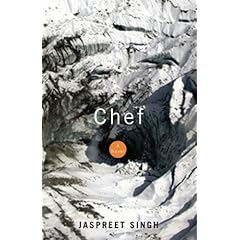
"I enjoyed Chef by Jaspreet Singh (Bloomsbury). Its themes of food and war and love and poetry form a series of intricate tightropes that the author treads skilfully, bringing us, in a short book, a lot of pleasures."
http://www.guardian.co.uk/books/2010/nov/14/best-books-of-year-2010-franzen

Dec 20, 2010

Aug 4, 2010

HEAVENLESSNESS

In Kashmir, near Kargil, there was an old man who knew how to climb the tallest mountain and become lighter than air. To keep alive he ate snow and when people asked him why he ate snow, he answered, “It is not forbidden.”
Always a trail of children formed behind him.
Once the boy Adi asked: “Baba, why do you keep climbing the same mountain again and again?”
“Boy,” he answered, “I am calculating the distance to heaven.”
Time passed.  The man correctly and satisfactorily calculated the distance. Yet, he never stopped trudging up the slopes of the mountain. He had grown very old and the boy had turned into a tall man.
“Baba,” Adi asked him one day with a smile, “now, why do you keep climbing? Isn’t it boring?”
“The distance to heaven,” the old man replied with a whiff of sadness, “is not a constant, as I thought earlier. It fluctuates. It changes, and changes with the population of the birds.”
 “This means,” the boy interpreted, “you will never be successful.”
The old man fell on his knees, smiled, and scooped up some freshly fallen snow from the trail. As he began eating the flakes one by one he turned to the boy and said, “All it means is that more work is required.”
More work is required.
[from Seventeen Tomatoes: Tales from Kashmir]

Jul 6, 2010

THE DECISIVE MOMENT

In my study the walls are covered with old black-and-white photos of Kashmir by Henri Cartier-Bresson. Bresson visited the valley in 1948, shooting pictures with his new way of seeing, the ‘decisive moment.’ He captured locals outside a mosque, Bhand Pathers, performance troupes, a solitary man in Shalimar gardens. My favourite is one in which five or six women in Islamic garments are standing on a sheer cliff. Only their backs are visible. Two or three are praying; one looking at the immense Kashmiri sky, another surveying the valley below—the poplars, the willows, the plane trees, the lake, the timber framed houses. Another stands bare-footed, her arms uplifted, palms open in prayer. A ribbon of a cloud is passing by and it is unclear if the cloud is touching her palm or the folds of the mountain. At the bottom left corner, a lonely shoe. One small push and it would fall into the valley... 

Jun 17, 2010

Siachen

HELIX
http://www.flickr.com/photos/naresharma/252557751/
COLDEST WAR Photos
By PRASHANT PANJIAR  and ROBERT NICKELSBERG
http://www.time.com/time/asia/photoessays/siachen/
SIACHEN WAR MEMORIAL


Jun 6, 2010

CHEF: Review

NEEL MUKHERJEE
http://www.neelmukherjee.com/articles/chef-by-jaspreet-singh/

The great strength of this brave book is its technique of indirection in imparting information to the reader. Singh comes at things aslant, seemingly casually; when their importance is revealed, it comes to the unsuspecting reader with the weight and shock of an unsuspected explosion.


Apr 17, 2010

CHEF

INDIA TODAY
http://indiatoday.intoday.in/site/Story/92084/Books:+Taste+for+peace.html


Chef, is a lyrical, literary exercise in capturing the lingering essence of lost peace in disturbed, disputed territory. 
It is a novel intricately woven through a complex metaphor of cooking, that activity which produces food to sustain life in a world of grim soldiering which wields weapons to destroy it. In doing so, it pits food against death, and makes a serious, poignant plea for restoring peace in the Valley. Sensitively, beautifully written ...


Apr 11, 2010

BOOK REVIEW: CHEF reviewed by EILEEN BATTERSBY


Returning to a life he made earlier

EILEEN BATTERSBY (The Irish Times)
Sat, Mar 20, 2010
FICTION: Chef By Jaspreet Singh Bloomsbury, 248pp. £14.99 


EVEN BEFORE he has opened his extraordinary debut novel, Indian writer Jaspreet Singh hints at what is to follow by prefacing it with a quote from the great Austrian, Thomas Bernhard: “The cold is eating into the centre of my brain.” That cold refers to the chill Singh’s narrator, Kirpal, is experiencing as he suspects his cancer is invading his mind. Weary and vulnerable, he boards a train bound for Kashmir. He has been summoned back to the place he had abruptly left 14 years earlier to return to Delhi, where he had since lived quietly, cooking for his mother, who is now ill. Kirpal is a cook, but even that, his vocation, was a thing of chance. His father, a soldier, had died a hero’s death, lost in the vast glacier that physically and symbolically divides India and Pakistan, causing his only son to travel to the camp where he had served, to join his father’s regiment.
Kirpal has spent his life watching, waiting to take some form of action. He blames himself, his guilt stalks him. While reliving his earlier life, he decides: “I have never been able to do what I really wanted to do. I am so weak.” Instead of becoming an active soldier, Kirpal’s career had been organised by the general, who sent him to be trained under Chef Kishen, a strange genius alert to the symbolism inherent in life, who saw Kashmir as a tormented Eden caught between India and Pakistan.
Chef is an elegant, angry novel, and curiously European in tone. It is worthy to stand among the finest of Indian writing, while also being different. It is bleak, solitary and intense. There are none of the familiar set pieces, none of the exasperated exchanges. There is no comedy. The tone is muted. Kirpal knows he is dying and has little time left in which to make sense of all that happened to him in the past.
Since the events of 14 years earlier he appears to have existed in a limbo. On the day he leaves the doctor’s office with test results amounting to a death sentence, he receives a letter from Kashmir, from General Sahib. That letter had been expected for a long time. The reason the general finally made contact seems somewhat banal: he wanted Kirpal, known as Kip, to prepare the wedding meal for his daughter, last seen by the narrator as a child playing with her dog. Singh imposes a powerful sense of drama on this novel. Kirpal is dying and aware that his mother is also failing. He has yet to tell her of his condition, but he knows he will return to Kashmir.
The train journey becomes a small epic and is handled with subtle grace and the impressive restraint which defines Singh’s prose: “Not far from me, a little girl is sitting on the aisle seat . . . Moments ago she asked her mother, What do we miss the most when we die? And I almost responded.” He hears the child’s mother dismiss the question by saying, “children should not talk about death”. The narrator confides: “Food, I almost said to the girl. We miss peaches, strawberries . . . The dead do not eat marzipan. The smell of bakeries torments them day and night.”
These wonderful sentences linger and Singh immediately consolidates their effect with a masterful touch: “Something about this exchange between mother and daughter has upset me. I look out the window.”
This is a portrait of a lonely, haunted individual. There is no self-pity, no melodrama. In a rare dart of irony, he notes: “This train is moving slower than a mountain mule. The engine is old, I know. It resembles me in many ways. But the railway-wallahs insist on calling it an Express .”
Returning to Kashmir causes him to revisit his 19-year-old self. Working under Chef Kishen had taught him about more than food. Sex and politics were also part of the training. The chef soon made it clear that once he had succeeded in teaching the boy, he, the chef, would move on to greater things. Chef Kishen was moved on, but in disgrace. The narrator had been assigned to discovering the mystery behind a female prisoner. The project ended disastrously. Throughout the novel, Kirpal the watcher is constantly learning, whether as his present self or as he once was, the young boy intent on following his father.
It was as a young apprentice cook that he was told the story of the horrible event that had dominated his father’s boyhood. One day when his father’s mother, the narrator’s grandmother, whom he had never met, insisted that his father, then a boy, went to school, he returned quickly because the school was closed, and found every member of his Sikh family had been decapitated; their heads arranged in a pile on a sofa. His father’s escape and subsequent survival cost him his culture.
Brutality and violence, the politics tearing asunder India and Pakistan, and between them Kashmir, seethe and fester in a novel of stark beauty. Unusual and slow-moving, Chef , longlisted for the 2010 International Impac Dublin Literary Award, is written with eerie grace and quiet courage. Late in the novel, the narrator recalls a conversation he had had on the bus with the woman sitting in the seat beside him: “For five and a half hours, almost half of the way, we were silent to each other, lost in our own worlds, and then suddenly we started talking . . . She was a Kashmiri Hindu . . . she said her situation was a bit like the exiles in the epic Mahabharata . I apologised for my limited knowledge of Hindu epics. I grew up in the Sikh tradition, I confessed. She studied my face carefully. So why, sardar-ji , have you cut your hair and removed your turban?”
The wedding banquet never happens, a death intervenes instead, truth continues to emerge. The calm, haunted narrator carefully gathers together anecdotes and details, memories and feelings, to tell a story as sharp as a blade.

Eileen Battersby is Literary Correspondent of The Irish Times and author of Second Readings: From Beckett to Black Beauty , published by Liberties Press

© 2010 The Irish Times


http://www.irishtimes.com/newspaper/weekend/2010/0320/1224266675280.html

Dec 20, 2009

With Mr. Joyce in Zurich

Then it began to snow...

Dec 18, 2009

Punjabi Tamatar, Spanish Tomates

Seventeen Tomatoes: Tales from Kashmir 
is now available in Punjabi (Hemkunt Press)
and Spanish (Paramo Ediciones)

                  Halka Dard


Nov 23, 2009

CHEF nominated for the Dublin Award

Chef has been nominated
for the 2010 International IMPAC
Dublin Literary Award


“Jaspreet Singh's Chef is an outstanding story about love and betrayal in a time of war, set against the beautiful and mysterious landscape of Kashmir.”

—David Albahari